
Are You Looking For Medical Records Storage?
Ensuring reliable and secure medical records storage is a fundamental responsibility for healthcare organisations of every size. Patient files contain sensitive personal information and must be handled with care, accuracy and respect for confidentiality at every stage of their lifecycle. We support healthcare providers, clinics and medical organisations by offering structured, professional solutions that help manage medical records safely while reducing the operational pressure that often comes with storing large volumes of information in-house. Our approach focuses on practicality, security and long-term organisation rather than making unrealistic promises about instant access or paperless systems.
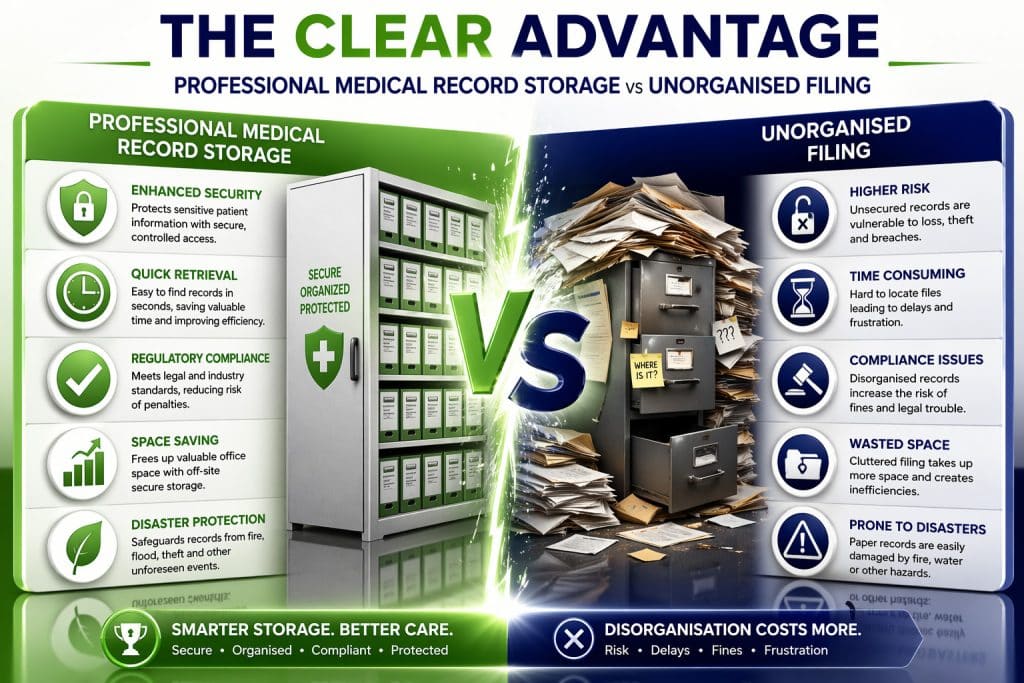
Medical records often accumulate over many years, particularly for organisations providing ongoing or specialist care. Paper files can quickly overwhelm office space and make it harder for staff to locate information efficiently. We help address this challenge by providing secure off-site medical records storage that removes the need to keep growing archives within working environments. Records are stored in controlled facilities designed specifically for document preservation, helping protect files from environmental risks such as moisture, dust or physical damage. Moving records off-site also allows healthcare teams to reclaim valuable space for clinical or administrative use.
Organisation plays a critical role in effective medical records storage. Poorly indexed or inconsistently labelled files can slow down retrieval and increase the risk of errors. We apply structured indexing systems that support logical record organisation and improve traceability. Files are catalogued clearly so that records can be located when required without unnecessary delays. While retrieval times depend on the agreed service model, having a clear inventory ensures records remain manageable and accounted for throughout their storage period.
Why Use Scietech for Medical Records Storage?
Security remains central to how we manage medical records storage services for healthcare organisations. Medical records require higher levels of protection than standard business documents due to the nature of the information they contain. Access to stored records is controlled and monitored, helping reduce the risk of unauthorised handling. Internal processes are designed to maintain clear chains of custody so records can be tracked from collection through to storage, retrieval or eventual disposal. Such controls help healthcare organisations demonstrate responsible data handling without overstating guarantees around absolute risk elimination.
Many organisations choose to complement physical medical records storage with professional scanning services. Converting paper records into digital files can support easier access and reduce reliance on physical handling over time. We provide document scanning services that allow records to be digitised methodically and stored in structured digital formats. Digitisation does not remove the need for careful data management, but it can help organisations reduce physical storage volumes and support more flexible working practices where appropriate.
Retention periods are another important consideration when managing medical records storage. Healthcare records often need to be kept for defined lengths of time depending on their type and purpose. Once those periods expire, records must be disposed of securely to prevent data breaches. We offer confidential document destruction services that allow organisations to manage end-of-life records responsibly. Secure disposal forms part of a complete records lifecycle, helping ensure that information is not retained longer than necessary.
Operational efficiency is often improved when medical records storage is handled externally. Internal teams no longer need to manage filing systems, oversee archive rooms or allocate staff time to manual record searches. Outsourcing storage allows healthcare organisations to focus on patient care and service delivery while still maintaining structured access to their records. Our role is to support these processes rather than replace internal decision-making or clinical responsibility. View our other services.
Different types of healthcare organisations have different storage needs, and flexibility is essential. Some records may require more frequent access, while others are kept purely for compliance or historical reference. We work with organisations to support varied storage requirements rather than applying rigid, one-size-fits-all solutions. Such flexibility helps ensure medical records storage remains aligned with operational realities and changing organisational needs. View other sectors that benefit from our services.

Your Questions Answered
What is medical records storage?
Medical records storage is the secure management and storage of patient files, ensuring they are protected, organised and accessible when required. This can include both physical records and digital files that need to be retained safely for operational and legal purposes.
Why is secure medical records storage important?
Secure storage is essential to protect sensitive patient information and maintain confidentiality. Healthcare data must be stored securely, kept only as long as necessary, and made available when required for legitimate use.
What types of medical records can be stored?
Medical records can include patient histories, treatment notes, test results, referral documents and administrative records. These documents form a complete record of patient care and must be managed carefully to support accurate decision-making.
How long do medical records need to be kept?
Retention periods can vary depending on the type of record, but many medical records must be kept for several years or even decades. In some cases, records may need to be retained long after a patient’s death to meet legal and clinical requirements.
Can stored medical records be accessed quickly when needed?
Yes, properly managed storage systems allow records to be retrieved efficiently when required. This is important for maintaining continuity of care and ensuring that information is available to authorised professionals when needed.
Are medical records stored in physical or digital formats?
Medical records can be stored in both physical and digital formats. Many organisations use a combination of secure physical storage and digital systems to improve accessibility while maintaining data protection standards.
How does medical records storage help with organisation?
Structured storage systems help businesses and healthcare providers organise records more effectively, reduce clutter, and ensure that important information is easy to locate. This supports better workflows and more efficient day-to-day operations.
Benefits
- Secure off-site medical records storage
- Protects confidential patient information
- Reduces on-site storage pressure
- Structured and organised record indexing
- Controlled access to sensitive files
- Supports long-term document preservation
Security
- Optional document scanning services
- Helps manage record retention periods
- Secure disposal of expired records
- Frees staff time and workspace
- Supports compliance-focused record handling
- Flexible storage for varying record needs
Important Information
Compliance considerations are closely linked to medical records storage and how sensitive records are stored and managed. Regulations around data protection, confidentiality and retention place clear responsibilities on healthcare providers. While legal compliance ultimately remains the responsibility of the organisation, using professional medical records storage services can support compliance efforts by implementing recognised best practices around security, organisation and controlled access. Experience in records management allows us to apply consistent processes that align with regulatory expectations without making claims beyond our scope.
Long-term preservation is another factor that healthcare organisations must consider. Paper records can degrade if stored incorrectly, leading to loss of information over time. Purpose-built storage environments help maintain document integrity, supporting the long-term accessibility of archived medical files. Preserving records accurately ensures that historical information remains available when legitimately required, whether for clinical reference, audits or legal enquiries. We also do storage for all types of documents.
Overall, medical records storage plays a vital role in supporting patient confidentiality, operational efficiency and responsible data management. We help healthcare organisations manage this responsibility through secure storage, structured indexing, optional digitisation and confidential disposal services. By applying practical systems and controlled processes, medical records can be stored, accessed and retired in an organised and accountable way that supports the ongoing needs of healthcare providers without overstating outcomes or guarantees.
GET IN TOUCH TO SEE HOW WE CAN HELP YOU
Can We Help You?
Enter your postcode below to see if we can support you.